
Trace Berrien County Former Owners
Build a former-owner search as a timeline, not a name list. Start with the newest matching deed and log one row per transfer. The recording date fixes the order. The grantor points to the prior owner. The legal description keeps the work anchored to the same parcel. Berrien County's recorded deed trail reaches back to 1831. Plats and probate files help explain name changes. But only recorded instruments form the conveyance chain.
| Transfer date | Grantor to grantee | Deed type | Reference |
|---|---|---|---|
| Newest matching record | Seller to present grantee | As indexed | Document number or book/page |
| Prior matching record | Earlier seller to that grantor | As indexed | Document number or book/page |
| Repeat backward | Each former grantee to the next | Warranty, quitclaim, or other indexed type | Legal description plus reference |
Treat the table as a working form rather than a sample chain. Copy names and deed types exactly as the Berrien County Register of Deeds search shows them. A warranty or quitclaim label names the instrument alone; it does not settle every title question by itself.
Four Fields Align Berrien County Former Owners
Four fields should agree before a transfer enters the chain. These are name, recording date, legal description, and instrument reference. Shared surnames, trusts, estates, and LLC punctuation invite false matches. The advanced search takes party names in last-name-first order. It offers separate grantor and grantee fields, date ranges, book, liber, page, document number, subdivision or condominium description, and unplatted description.
Street addresses make weak historical keys. A deed may carry only a lot-and-block or metes-and-bounds description. Once found, preserve the full parcel ID. Keep relying on the deed's legal description as the stable bridge between records. The Berrien sample APN contains many zeroes plus a final suffix. A partial copy can land on a different parcel entirely.
Note: Record the exact spelling from every instrument, then test initials and punctuation variants only when the legal description still matches.
Search Berrien County Former-Owner Indexes
The Register of Deeds quick search separates its default index search from full-text OCR. With two or more words, index-only mode searches each word separately. OCR treats the entry as an exact phrase instead. That makes the index the sound first route. It works for names and indexed descriptions. OCR can help when a phrase sits in readable document text. A poor scan or wording variation may defeat it.
| Search control | Best chain use | Format clue |
|---|---|---|
| Grantor | Find when a known owner conveyed the land | LASTNAME FIRSTNAME |
| Grantee | Find when that owner acquired the land | LASTNAME FIRSTNAME |
| Subdivision/Condo | Hold a platted chain to the same lot | Use recorded subdivision wording |
| Unplatted Description | Follow metes-and-bounds land | Use distinctive description terms |
| Book, liber, page | Retrieve a known earlier reference | Copy numbers exactly |
The portal posts a certification date of September 3, 2026, a freshness marker rather than a permanent statement.
The official advanced deed-search screen shows how the party and description fields are arranged.
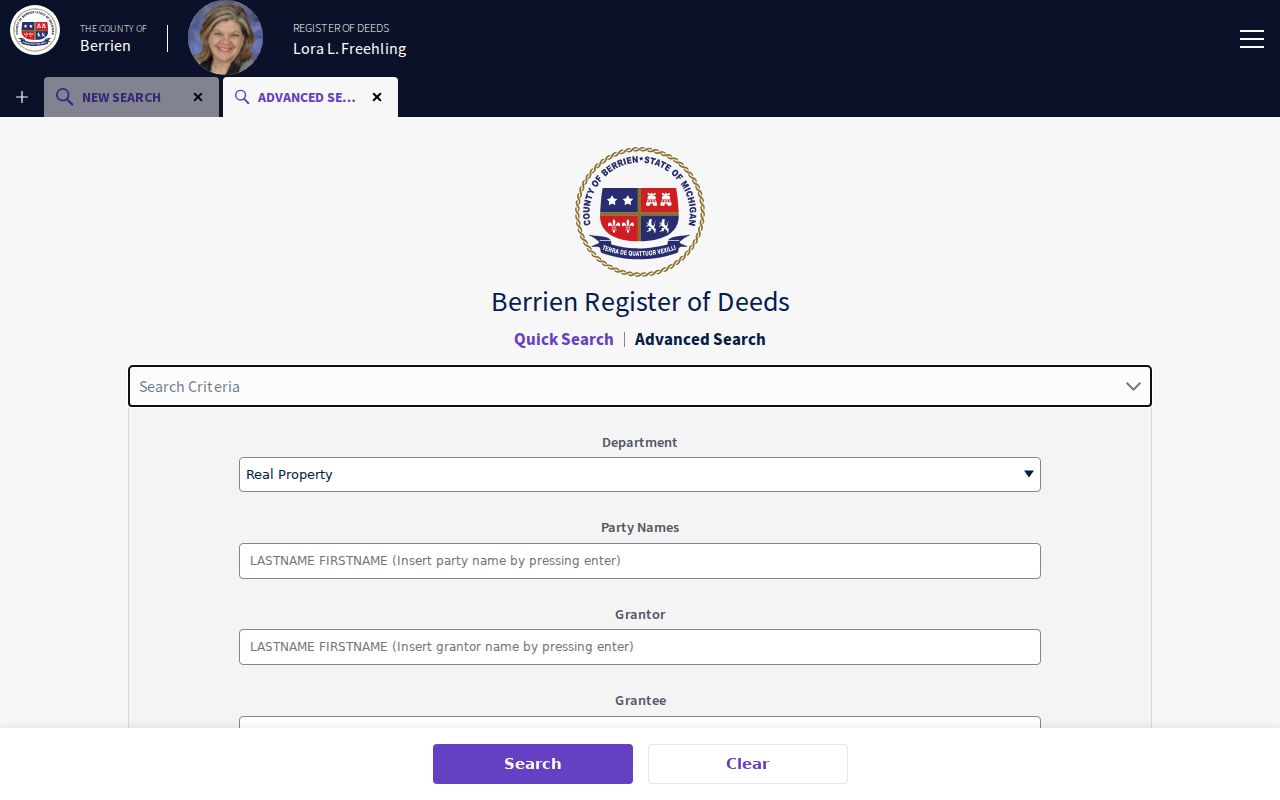
That layout shows why grantor and grantee roles, dates, and descriptions belong together in every backward step you log.
Reconstruct Berrien County Previous Owners
Start from a verified current parcel. Work backward one conveyance at a time. Avoid gathering every deed under a surname to sort later; the narrow sequence makes each prior owner prove the next search term.
- Use the assessor or parcel record to obtain the present taxpayer name, full APN, legal description, and any liber/page reference.
- Find the newest matching deed where the present owner appears as grantee; verify the description and recording date.
- Copy that deed's grantor, then search that person or entity as grantee to locate the acquisition deed.
- Repeat the grantor-to-earlier-grantee step and log each document number or book/page until the chain reaches 1831 or a gap.
- Grantor / grantee
- The conveying party and the receiving party named in a deed.
- Chain of title
- The ordered series of instruments by which ownership passed.
- Reverse index
- A route organized around grantees that helps locate how an owner acquired land.
- Quitclaim / warranty deed
- Different deed forms; neither label substitutes for reviewing the instrument and chain.
Keep the backward worksheet separate from the task of ordering a single copy when the chain is the real goal. The Berrien County deed records guide covers copy choices and deed mechanics in more depth.
Probate Bridges Berrien County Name Changes
A clean deed sequence may seem to stop when an owner died. The Berrien County Estates page identifies informal and formal probate materials. These name the decedent, personal representative, heirs, and their authority. Search the deed index under both the deceased owner and the representative. Look there for an executor's, administrator's, or other estate-related transfer.
The probate file shows who could act. But it does not itself prove real property changed hands. The chain resumes only when a matching recorded instrument connects the parcel. Joint ownership or another route may mean no probate deed ever existed. In that case, record the gap rather than inventing a transfer.
Berrien County Plat Sheets Anchor Former-Owner History
The county's Subdivision Maps index sorts map sheets by local unit. Benton uses sheets 3A through 3E. Niles offers location maps and sheets 14A through 14H. St. Joseph carries a location map plus 19A and 19B. These labels are finding aids, not the recorded plats themselves.
For rural history, the Library of Michigan lists a 1959 Farm Plat Book with an owner index. It also lists a 1930 Hixson book, a 1973 atlas, and a 2005 county plat book. For a platted lot, compare the deed's subdivision, lot, and block with the recorded plat. That plat is held by the Register of Deeds. Such volumes can suggest an earlier farm name or road context. But they do not convey title.
Note: A directory, atlas, obituary, or tax reference is only a clue; a matching recorded transfer belongs in the deed chain.
Continue Berrien County Former-Owner Searches Offline
Online deed coverage runs deep, but tangled chains sometimes need a person at the counter. The Register of Deeds sits at 701 Main Street in St. Joseph. Public terminals there are open 8:30 a.m. to 4:45 p.m. Staff answer questions at 269-983-7111 extension 8562. A common name can flood the results. Bring an exact legal description, a book and page, or a document number.
Copies move through mail, phone, fax, and in-person channels alongside the online index. Real-estate copies run $1 per page. Plats and oversize pages cost $3 per page. Certification adds $5. Online orders carry that same $5 card fee. A staff search runs $0.50 per name per year with a $5 minimum. Self-searching at a terminal skips the charge entirely.
For archival digging, the Archives of Michigan county guides catalog Berrien land, probate, court, township-plat, and business record groups. Confirm the box or volume number before driving to Lansing.
Berrien County Former-Owner Record Depth
Berrien County dates to 1831, with formal organization following in 1835. Per the Register of Deeds, deed indexes and images span 1831 to the present. That makes 1831 the earliest documented online deed year. Mortgage, assignment, and discharge records are a different story. That separate coverage begins in 1950. A deed chain reaches far deeper than a mortgage history.
No official account confirms a courthouse fire or any pre-1831 online deed collection. Earlier land questions belong with the Register of Deeds. The finding aids sit at the Archives and Library of Michigan. One clue helps with old references. The county seat moved to Berrien Springs in 1837. It returned to St. Joseph in 1894. An older record naming a different seat still points to the right era of paperwork.
Coverage limit. The verified online deed trail starts in 1831. Treat anything earlier as an archival question, and never fill an unexplained chain break with an assumed owner.
Former-owner records support house history. They also help with estate work and purchase diligence. They must never serve to track, threaten, or harass a living person. Keep in mind that a reconstructed chain is not a legal title opinion. Unresolved gaps belong with the Register of Deeds. A qualified title professional can help too.